

I like to think of myself as a rebel, what with my safety-pin-studded leather jacket, my neck tattoos, my horseshoe mustache, and my badass Harley-Davidson.
But in reality I’m a rule follower, begrudgingly but nonetheless obedient.
I stop on yellow, I floss daily, I rarely kick dogs. But most of the rules in my life are ones I set myself.
Case in point: The Ten Commandments of Art Making.
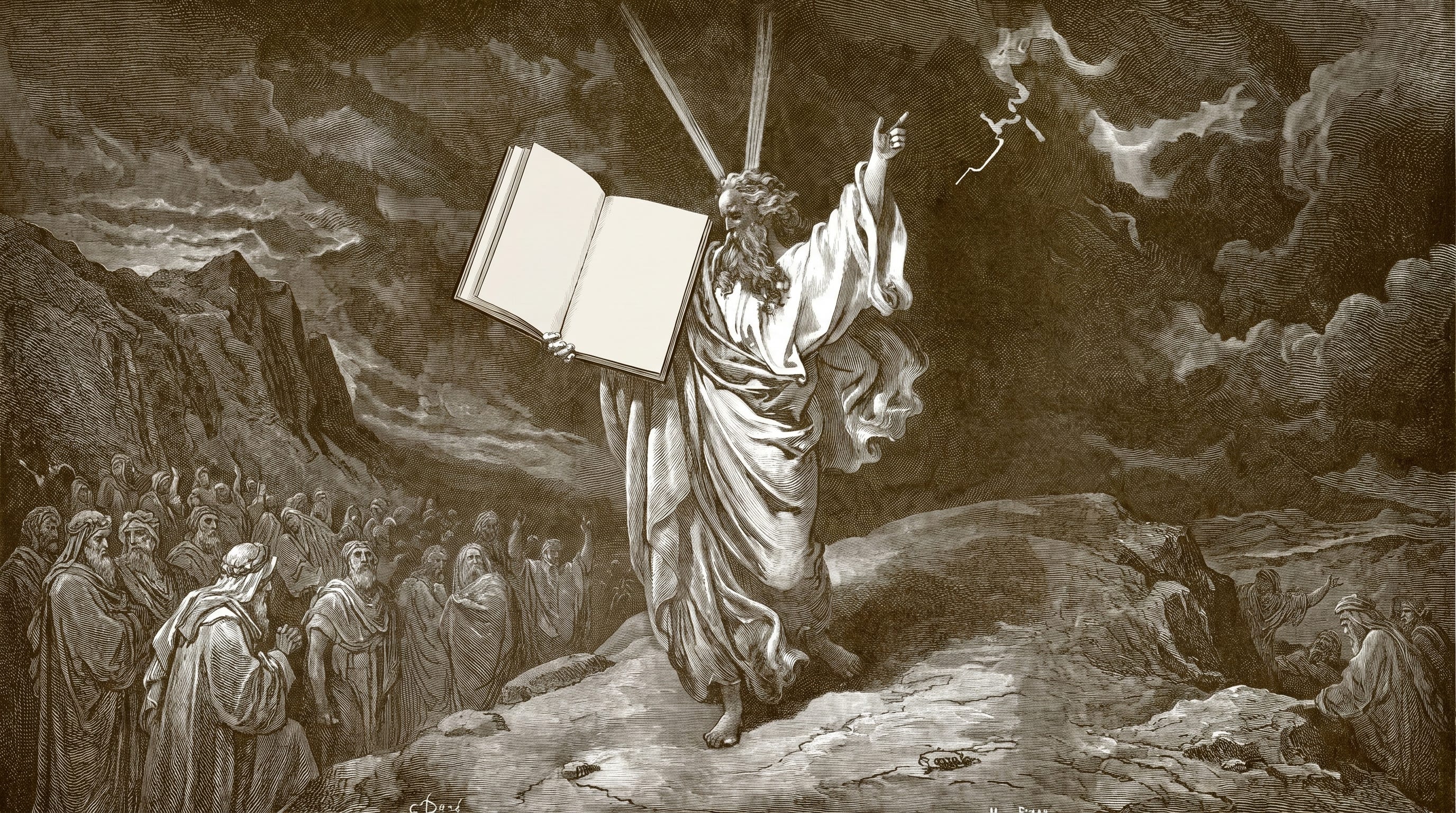
I. Thou shalt not draw with a pencil. This is the holiest of my commandments, the one rule to rule them all. Pencil lines can fade, smudge, and most importantly, be erased. Always draw it in ink.
It’s a law that has served me well. It helped me develop confidence in my line because whatever I drew remained there indelibly on the paper. I couldn’t approximate, hem, haw, or shilly-shally. Those black lines are forever, which means I reflexively pause to consider for a moment before I start to draw, making a commitment before I make a mark.
I’ve passed this rule down for decades, inscribing it in books, in lectures, in videos. I’ve backhanded many a whining beginner, terrified of an ordinary ballpoint pen. I get up in their face like a drill sergeant, demanding they toughen up and uncap their pens.
And yet.
I own pencils. I own erasers. And I’m finally willing to admit I’ve used both.
Last year, I committed to 31 days of Inktober, creating full-page illustrations completely out of my imagination. Composing the pages required a lot of thumbnailing and rearranging. I discovered how wonderful it is to be able to do a light pencil sketch and then erase and rearrange bits. The results were still wonky, but the armature of graphite gave me the confidence I needed.
Nonetheless, especially for beginners, this, the cardinal rule, is still pretty much inviolable, sacrosanct, written in ink.
Do as I say. Not as I do.
II. Thou shalt not draw from photos. Draw from reality whenever possible. Cameras see with one eye and flatten reality so it’s easier to transfer onto a two-dimensional page. When I draw from three-dimensional reality, I have to do that work myself. It’s harder, but it inclines me to make decisions on my own and study my subject all the harder. Most reference photographs are the work of someone else, a photographer who decided the framing, composition, palette, and focus.
These days, a lot of my drawing is based on reference photographs. That started as a necessary evil during the pandemic, when I began doing a lot of live streaming and needed to share my reference with people on YouTube.
But whenever possible, I like to sit in front of my subject, reposition myself to get the perfect angle, close one eye, then the other, measure with an outstretched thumb, and only then begin to draw.
This is another rule that I think is an extremely good idea, especially for beginners, who need to learn to make these decisions for themselves.
III. Thou shalt not start a new sketchbook if the current one isn’t full. The first dozen or two sketchbooks I kept were completely consecutive and chronological. Cracking open a fresh sketchbook was a reward for having finished the previous one.
This rule meant I was stuck with the dimensions and paper type of the current sketchbook. This turned out to be pretty helpful. Even if I wanted to try something different, I had to continue working within the confines I’d set until I was done. That kept me focused and working on the particular challenges the sketchbook posed.
I couldn’t just walk away from the problem. I had to keep trying to solve it.
Over the last couple of decades, there have been so many new options when it comes to sketchbooks: all sorts of shapes, sizes, colors, and paper types. Rather than hitting my head against the edges of the particular book I was working in, I’ve come to see all these options as tools to suit what I’m doing. If I feel like working with watercolor one day, a dip pen the next, colored pencils, alcohol markers, gouache … I don’t have to wait until the current book is filled. I can experiment with toned paper, square paper, hard press and cold, bristol, a larger size, or a smaller one.
I now have shelves of sketchbooks that are not completely filled and are not sequentially numbered. They have allowed me to experiment and play, and relaxing this particular rule has helped me grow.
That said, I still advise beginners to stay the straight and narrow until they have a decent stack of completely-filled sketchbooks under their belts. (Which sounds uncomfortable. Don’t carry stacks of sketchbooks under your belt.)
IV. Thou shalt not frame your art. You won’t find many of my drawings and paintings hanging on the walls of my house and, if they are, they’re probably held up with thumbtacks.
It’s not that I don’t like my art or think it looks good on the wall. It’s more that I don’t like the feeling of creating something that will be decorative and out of context.
I strongly believe in being a sketchbook artist, and that means I work in a book that can be held in your hands and looked at page after page. I think that experience creates an entire world that the viewer enters as they turn the pages, a chronological sequence of images that relate to the ones that precede and follow it. It’s very different from making a drawing to hang above the toilet.
This is a rule I apply only to myself and don’t expect anybody else to follow it. It has helped me keep my art personal and authentic.
V. Thou shalt not sell your art. I’ve never entered a show or put my work in a gallery (partly because no one’s ever asked). I feel my art is connected to me, the output of my own personal process, and turning it into a product seems out of sync with that. I just couldn’t imagine some stranger paying money to take one of my journal pages and put it in their home.
That being said, I have done illustrations for magazines, newspapers, websites, and, of course, more than 20 books of my own and others’. But it’s my least favorite way to make art, and I always feel like it puts me back to my old days in advertising with clients and work orders, a completely different process from what I make for myself.
VI. Thou shalt not use an eraser. As a follower of the Church of Wonkiness, I love seeing the process of my drawing on the page, the palimpsest. Mistakes, ink splatters, redrawn lines, are all part of my aesthetic. Mistakes are proof of humanity, of accessibility, of authenticity. So many of my favorite artists feel the same way. We don’t try to be perfect. We’re willing instead to be true.
However, I love my Pentel Presto white-out pen.
I’m not trying to hide that I use it, and I’m not trying to obscure my mistakes, but sometimes a big blunder can be annoying and get in the way of some other purpose in making the drawing. It’s okay to patch over a section of a drawing that you’re not happy with or paint it out with white gouache or even (shudder) use an eraser.
I think flexibility with this rule is a sign of my developing maturity. As long as I’m not being dishonest in my process, it’s perfectly fine. To erase is human.
VII. Thou shalt not make digital art. I think this stems back to an earlier time when drawing on a computer meant using Illustrator and drawing with a mouse. A lot of people dislike digital art and when I made my course, “How to Be an iPad Artist,” I felt compelled to keep saying that I also thought digital art was cold, sterile, or ugly, but that the iPad was changing my tune.
When I first started using Procreate, my inclination was to try to reproduce how I worked in my sketchbook, so I tried to simulate watercolor, textured paper, and writing with a dip pen. After that proved to be a hopeless pursuit, I had to admit that this is a medium with its own aesthetics. Rather than fighting it, I began to lean into bright colors, layers, smooth lines, and all the experimental techniques I was discovering. I use my iPad every day now, and the art I make on it is as much me as anything made on paper. In some ways I like working this way even better. After all, I can’t play Miles Davis on my sketchbook.
VIII. Thou shalt not use gouache. I love watercolor — the poetry of layering glazes, the soft edges, the organic effects of pooling water. Gouache seemed ham-fisted by comparison, the blunt tool of fabric designers and 1950s illustrators. (I actually love a lot of 1950s illustrators, so this wasn’t particularly fair.) It was one of those knee-jerk rules that probably came from the tube of white gouache that lurks in every watercolor set. Mixing in opaque white felt like cheating — like putting ketchup on eggs.
Over the last year or so I’ve been painting with gouache fairly regularly. In some respects it harkens back to painting with acrylics as I used to when I was a kid, but without the slightly plastic feeling that acrylic has for me. I love the matte, chalky effect of a thick layer. Painting with opacity and mixing colors is a completely different skill than glazing. It’s not worse, it’s just different.
IX. Thou shalt not use synthetic brushes. Synthetic brushes used to be absolutely awful. They were slippery, they didn’t hold water, and they really intruded on the experience of luscious glazing with watercolor.
One of the miracles of the 21st century is how far the science of brush-making has come. Honestly, not only do I now use synthetic brushes, I prefer them to my Series 7 Winsor Newton Kolinsky sable brush. I also prefer not butchering innocent animals to hack off their tails.
X. Art has no rules. Yeah, I totally still believe this one. Rules suck.
Your pal,
Danny
P.S. I just made one of my favorite videos in a really long time, and it’s related to where a lot of these rules came from. It’s about how I first started my sketchbook practice, but it’s also about what my life was like then. For the first time ever, I am sharing some films from the time that were just wonderful to work with. I hope you enjoy it. Please leave a comment, give it a thumbs up, and subscribe.
I have a new rule. So new it’s never been followed. Kinda scared of it. Alan Moore says art changes consciousness and consciousness changes reality and so there is no better definition of magic than art. So the question is, what spell are you casting? Have you answered that? What magic does THIS cast?
A lot of what we think are our own rules are things we've been told by others, consciously or unconsciously. I think it's helpful to examine our 'rules' every now and then, and see if they still serve us or not.