

It was just one of those days, I guess.
Last Thursday, maybe you were there.
I decided it would be a good idea to use a piece by Norman Rockwell as a reference in Draw with Me. Jenny and I had just been to the new Lucas Museum of Narrative Art in Los Angeles, and had a great time wandering through several galleries of his original paintings and drawings. I thought it would be good inspiration, but I decided to interpret the scene in my own style. I’d create a wonky abstract expression that came from inside me, not Norm.
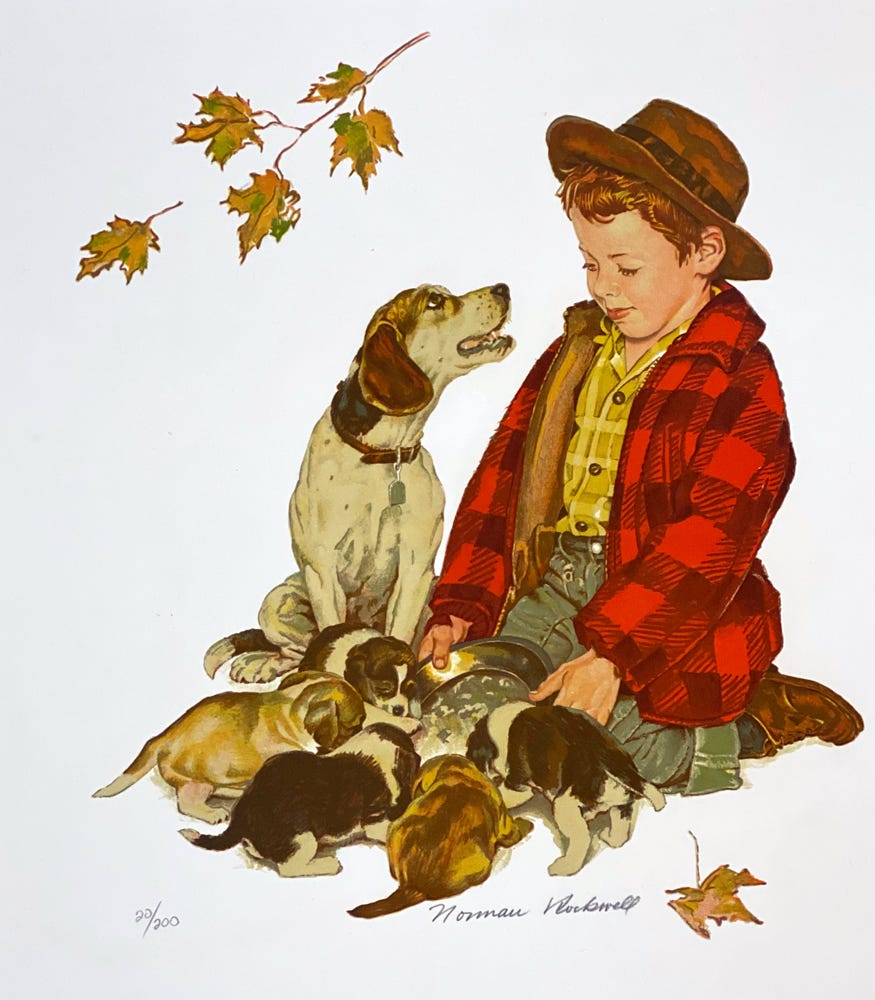
I put up the image of a boy, his dog, and a pile of puppies, and plunged in. I could tell from the silence of the YouTube comment stream that I wasn’t the only one a little intimidated by what we were setting out to do. I breathed deep and started working my way down across the boy’s fedora and cowlick, but pretty quickly realized that I was trying to copy Rockwell’s drawing exactly. That wasn’t the plan, and I wasn’t very good at it. I was forging. But I forged ahead.
My anxiety started to mount. I made his face the wrong shape, I made his forehead too long, put his head at the wrong angle, and I didn’t leave room for the puppies. One thing after another. 15 minutes into it, I had accepted that I was failing and doing so in front of a large live audience. I made excuses, gave up, and turned the page.
I don’t usually quit on a drawing, and I encourage others not to either, but I felt trapped and desperate. I imagined I could hear gasps, snorts, snickering.
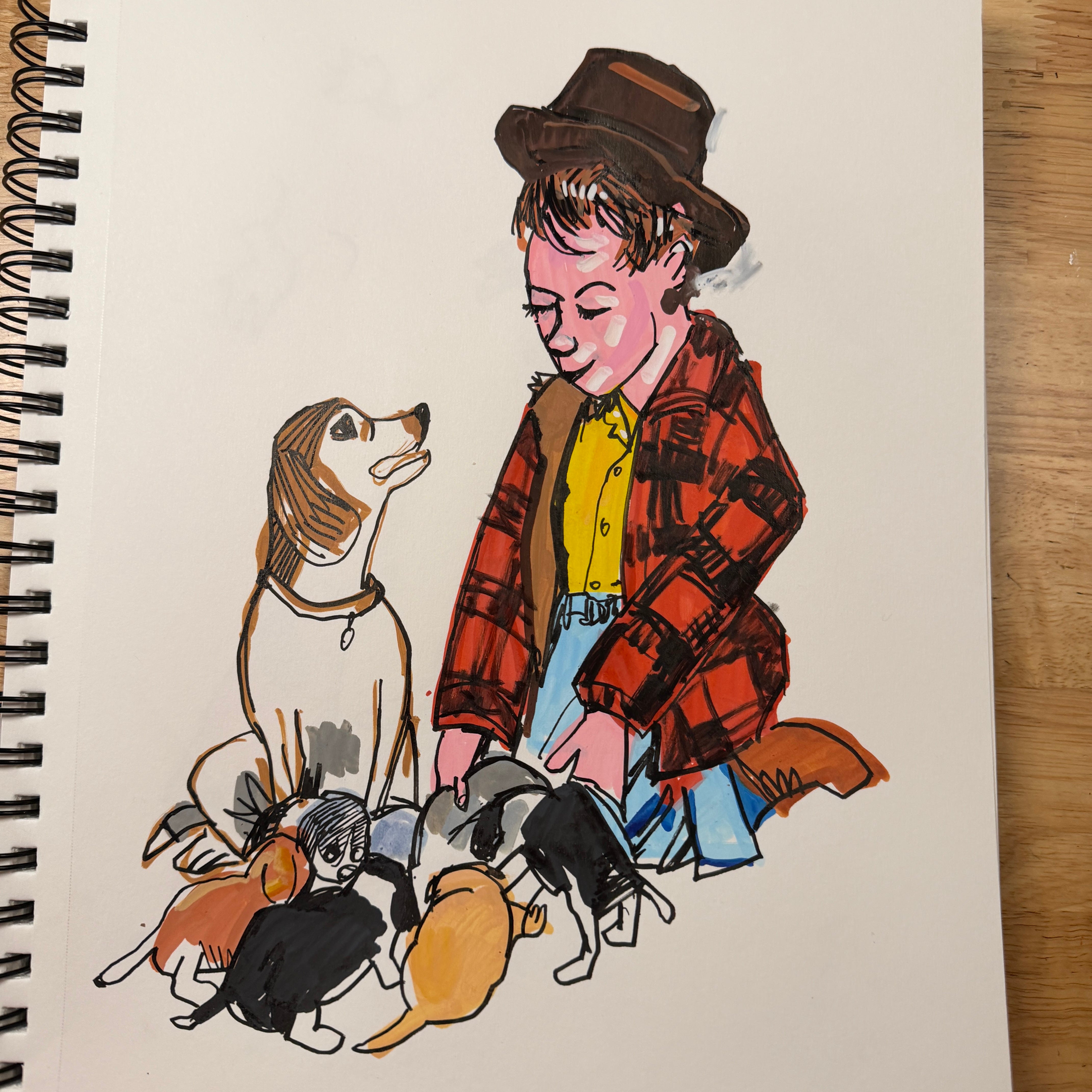
My second attempt was fast and loose. I stopped thinking about what I was doing, stopped judging where I was going, and simply scrawled my way across the page. In a couple of minutes, I had done a much looser and wilder version of the piece, and then time was up. The hour had ended.
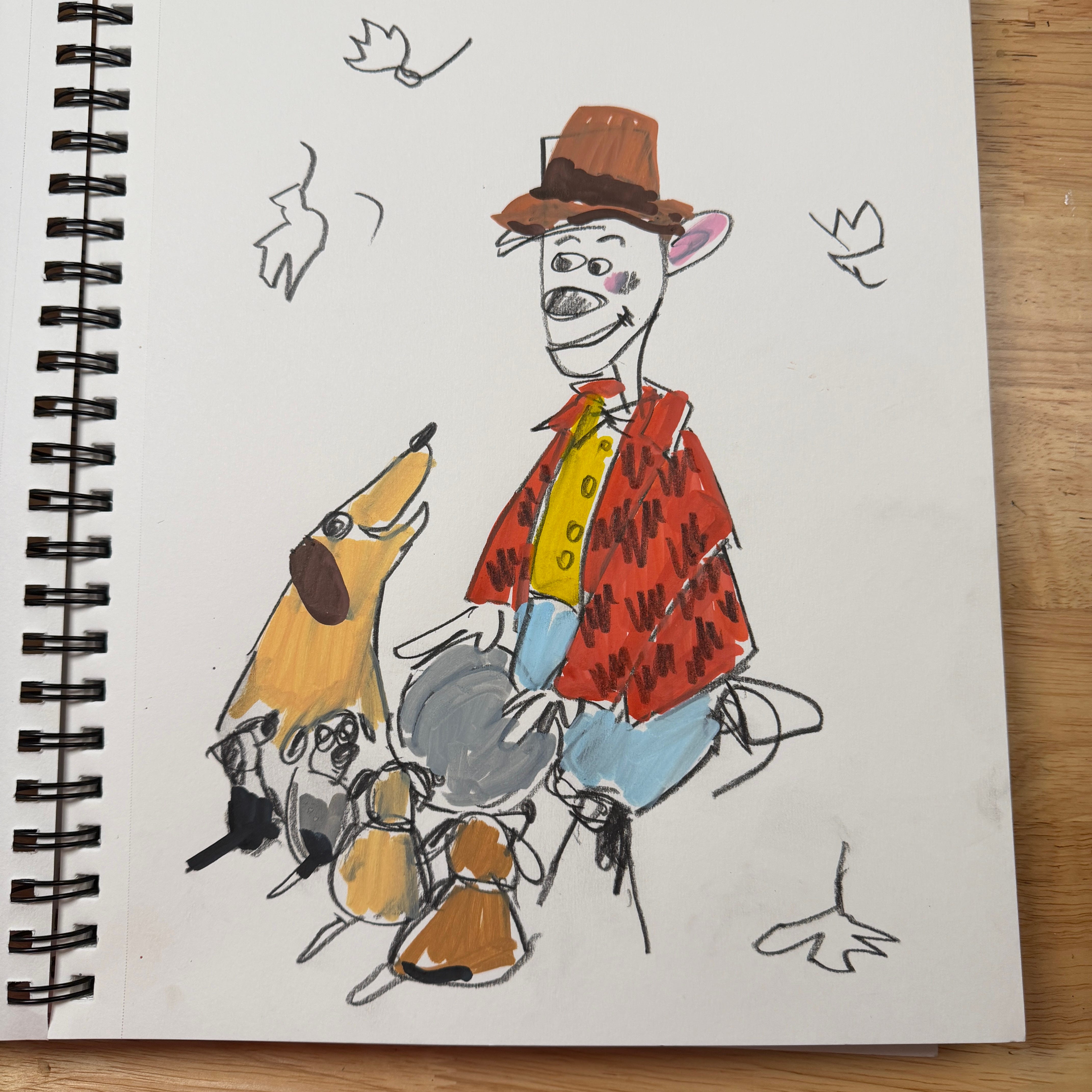
I berated myself, I whined, I wheedled. But I had not given up hope. In the back of my mind I thought, “I’m going to try one more, one last time, but I’ll do it off camera.” I settled down after a cup of tea and tried a third interpretation. I made it much more the way I’d imagined: geometric, abstracted. Instead of half a dozen puppies, I added in a crowd. My lines were more confident. The piece felt better.
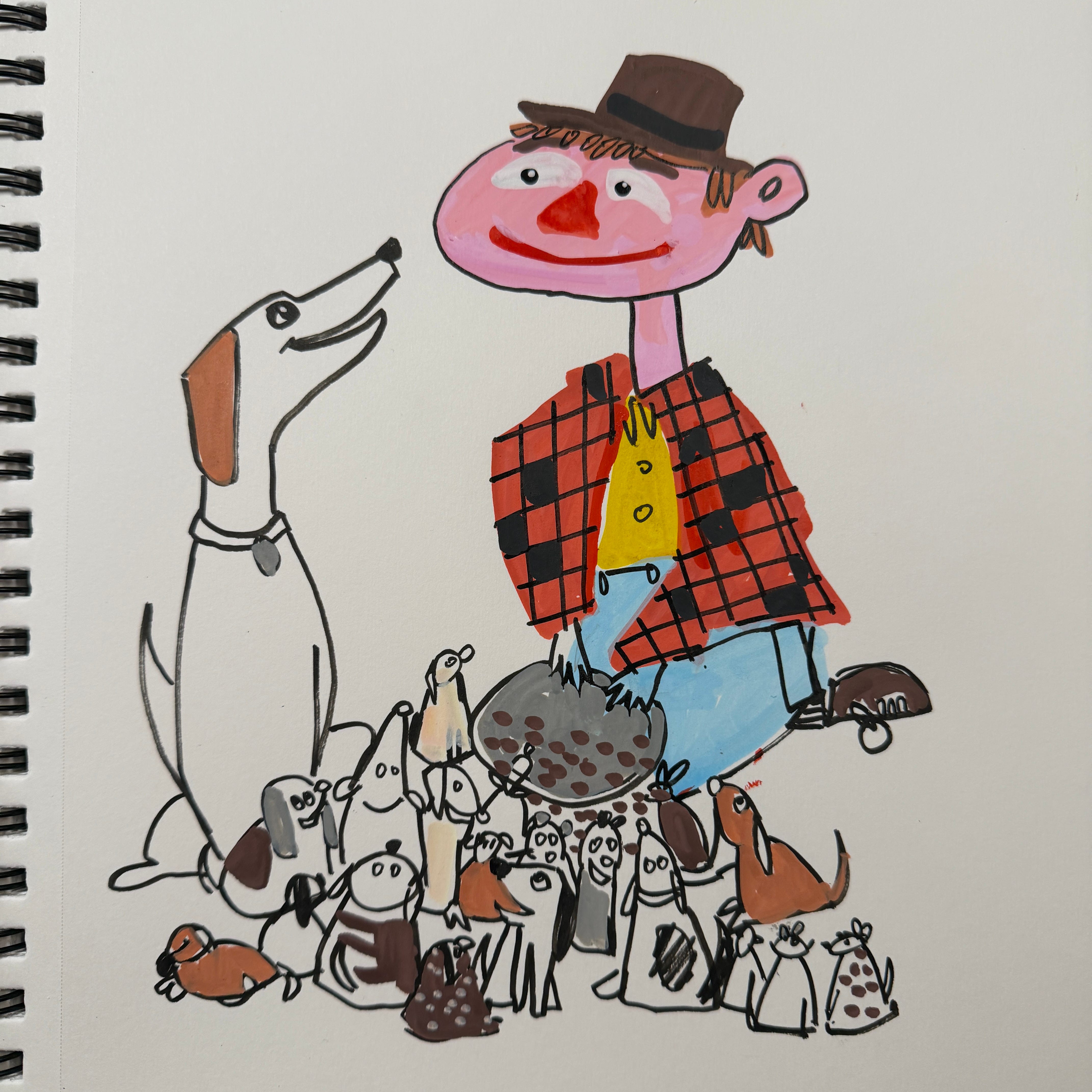
I put it aside because I had more pressing work to do.
I hadn’t yet written the essay I normally sent out on Fridays. I decided I would continue the theme of pets. I pounded out a history of every pet I’ve had since I was a kid. I juiced my memory to squeeze out details. In a thousand words, I covered 60 years of furred and feathered friends.
I decided to send it out right away rather than waiting until Friday morning. I felt happy about writing the essay, and I just wanted to share it. Off it went.
It didn’t take long for the first readers to email me back. Some said that they found the story sad, uncharacteristically so. For the first time since I’d written it, I went back and read the essay through again.
I saw what they meant. I’d fallen into a rhythm, using the same line at the end of each section about how I never saw the pet again. What had begun as a dog-walk down memory lane had turned into a requiem.
Why had I imposed this litany of death on my readers? Who wanted this? I felt like I had polluted their mailboxes with darkness and gloom. I’d have to rectify things with a chipper essay — but I had no time or energy to write another one.
So I went back through my archives, archives that have essays going back decades. I pulled one out I wrote in 2022, about Twiglet and how her wonkiness reminds me of my relationship with my art. I tweaked it and prefaced it and, by midnight, it was winging out to my subscribers, praying that they would read it before my obituaries had soured them on me completely.
Thursday blew into Friday, then into Saturday morning, when I was teaching a workshop on how to draw pets. Midway through my long demo, when my watercolor glazes looked like Jackson Pollock’s laundry basket, one student typed into the Zoom chat, “This is the stage where I would normally give up.”
I knew what she meant. It was the ‘ugly stage’ that so much art goes through, the point where you must decide to give up and go home, or just maybe push through to higher ground.
When I looked at this dog’s breakfast of pigment puddles, I knew exactly where to put the few crucial strokes that would reveal a decent portrait of a German Shepherd. Sure enough, a couple of minutes later, he sat up and barked. The students breathed a sigh of relief.
After a week of thinking about it, I’ve boiled this whole affair down to two factors.
The first is intention. When I know where I’m headed before I start, I have something to measure the work against. I’d meant to interpret Rockwell, not copy him, but I hadn’t thought much about how. The struggle to copy the reference pushed the plan out of my head, and I started judging myself by the wrong standard. I was no longer making something of my own. I was aiming for a reasonable forgery.
The second is time. When I look at my ‘Rockwells’ now, after the smoke of the battlefield has cleared, I think they’re … fine. They’re just three drawings, an hour, nothing more. And I rushed through that essay. Normally I write on Monday, then reread and tweak all week before it goes out on Friday. The pets essay went out within hours of inception, and I’d barely scanned it. Two or three emails called it glum, and I thrashed around for a solution.
In the days after I published my essays, I got a lot of other responses from readers, most of them recognizing my original intentions and sharing how much they’d enjoyed what I wrote. I read it again and decided it was a perfectly authentic reflection of how I felt. I don’t set out to make people sad, but sadness is a part of life. I had overlooked that truth on my first reading.
The creative process has distinct phases, and when they overlap and blur, it can be hard to know what I’m doing.
At first there’s this feeling in my gut, this sense of wanting to make something but not knowing exactly what it would be like. It’s a general destination, a direction, a compass bearing. Next there’s the doing: following that charted path but being willing to meander with it if need be. Should the map be too detailed, it robs me of the adventure.
And last, I’m ready to judge where I am. How’m I doin’? It’s tempting to rush to judgment because I want assurance; I want clarity. Frankly, the results aren’t yet in. The cake is half-baked.
A week’s gone by, and I spent a lot of it thinking and learning rather than licking my wounds and beating myself up. Time well spent.
Your pal,
Danny