

There’s a big cardboard box I’ve been carrying around most of my life. It’s battered, taped together, and dusty — scrawled on the side are the words “writing archive.” Inside are hundreds of pages of stories, essays, and letters, some dating back to grade school. School assignments with a teacher’s notes in the margin. Essays for the high school newspaper. Half-books written in my twenties. Drafts of love letters to girls who are now old women.
But most of this writing has never been read by anyone but me.
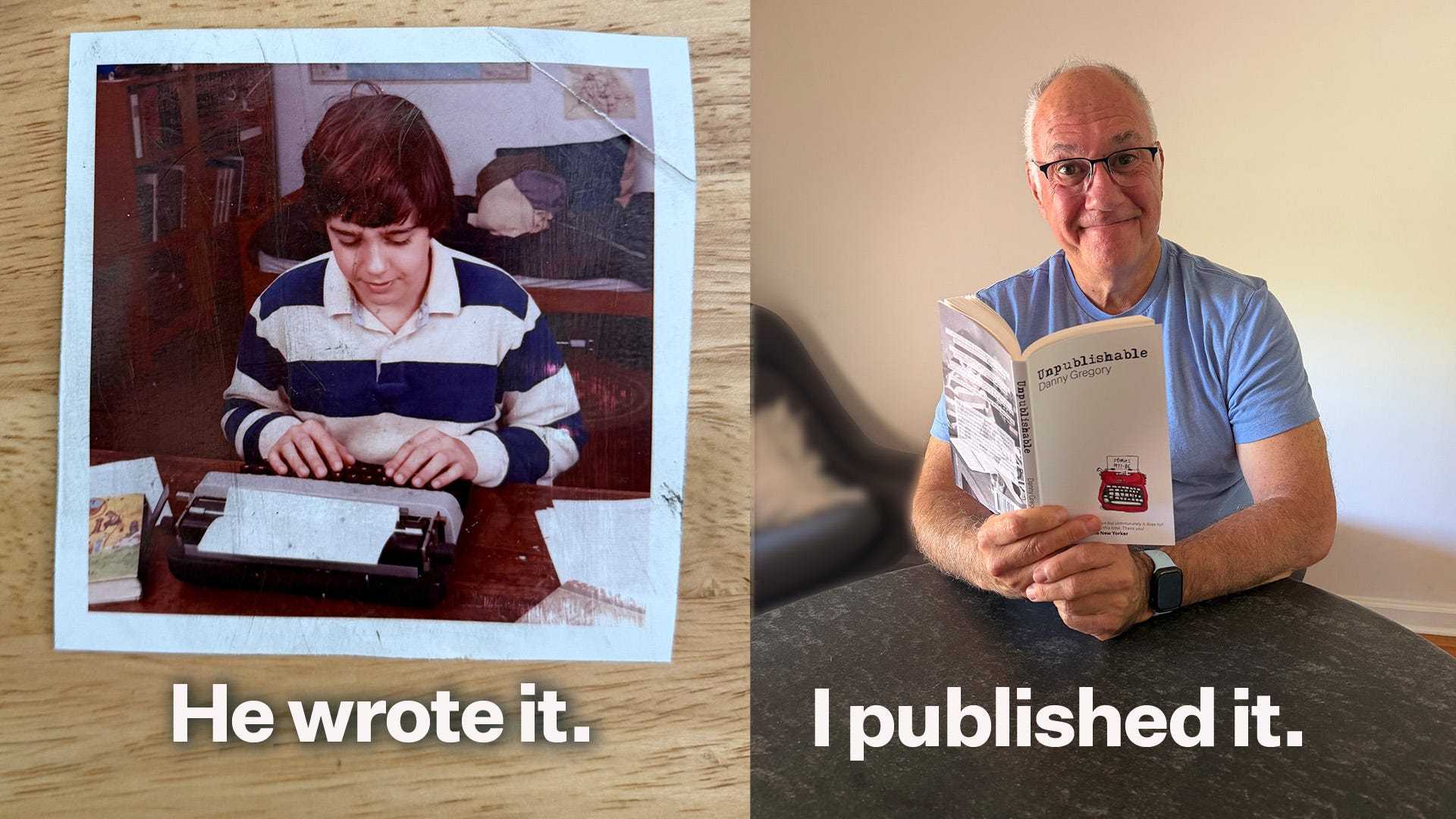
I always wanted to be a writer. I loved creating people and worlds that never existed, turning some vague notion into a character or a scenario that reveals itself as you write it. Every author I read dropped a bit of influence into the cauldron — P.G. Wodehouse and Henry Miller, Robert Benchley and James Ellroy, Hunter Thompson and Enid Blyton, all cribbed shamelessly. Some of the stories are funny. Some are tragic. Some cut off mid-sentence. Some went through a dozen drafts.
Back when I was writing as a teenager and in my 20s, there was no internet, no social media, and self-publishing was considered vanity. It seemed the only way to have a book with my name on its spine was to somehow figure out the game of publishing.
There was a fat annual book called Writer’s Market. I’d take it out of the library, copy addresses of publishers, run my stories off on the office copier, and mail them out in manila envelopes. Weeks later, my self-addressed stamped envelope would come back with a pristine copy of my manuscript and a form rejection. I did this dozens of times. Then I stopped.
The writing ended up in the box.
I had teachers who believed in me — Ms. McIlnay in ninth grade, Don Knies after her. I applied to a creative writing course taught by Joyce Carol Oates. She didn’t think my work belonged there. I wrote a play at 22 that came close to Broadway — Kevin Bacon wanted the lead — and then it collapsed under its own ambition, and I became a copywriter instead of a playwright.
Over the next few years, I guess I just gave up on the idea of being a fiction writer.
I started blogging in 2003, and journaling and essays are where the effort has gone ever since. That, and advertising copy —I’ve written so many print and television ads, and that’s where my writing flourished.
Underneath it, though, I’d decided I was a failure as a fiction writer. None of those stories got out of the box. No agent, no publisher, no shelf at the local bookstore.
I figured I was missing some key ingredient.
Eventually I did get published — a dozen or so books over the years, and lately I’ve been my own publisher, releasing essay collections for subscribers. But that cardboard box sat in my garage in Arizona for six years, gathering desert dust. I still see it in my dreams. And then I decided it was time. I hauled it into the studio and cracked it open.
There was good stuff in there.
I decided it was time to give that ten-year-old, that twenty-year-old, his own name on a spine. I’d print at least one copy and put it on the shelf next to the others. Proudly.
I sorted through the manuscripts and picked about thirty — funny, sad, insane, derivative, all of them my children. Or maybe my grandchildren at this point. Most were typed and paper-clipped. Some handwritten in pencil, crossed out, scribbled over, notes in the margin. I decided not to rewrite a word of the original voice. I’d only fix typos, spelling, punctuation. A real book.
My plan was to make a book that seemed like it had been published in the mid-90s, around the time when I stopped writing stories. The book 25-year-old me dreamed of holding, author photo on the back, a blurb or two from someone official-sounding on the cover. Figuring out what a 1995 short story collection actually looked like took a trip to my favorite second-hand bookstore, hunting through old paperbacks for the right font and page layout.
I designed a few covers, tried a few titles. I keep coming back to Unpublishable — a word that showed up more than once in my rejection letters. I like the idea of it: guess what, this unpublishable thing is being published. A wink to the kid who got the form letters.
I’ve written a short introduction for each story, a little context before you go in. Honestly, there are some I don’t remember writing at all, and since none of the manuscripts were dated, I’ve had to guess when. Doesn’t matter much. There are no scholars of my work — though if some misguided PhD candidate ever wants to carbon-date the paper, the box is right there in the garage.
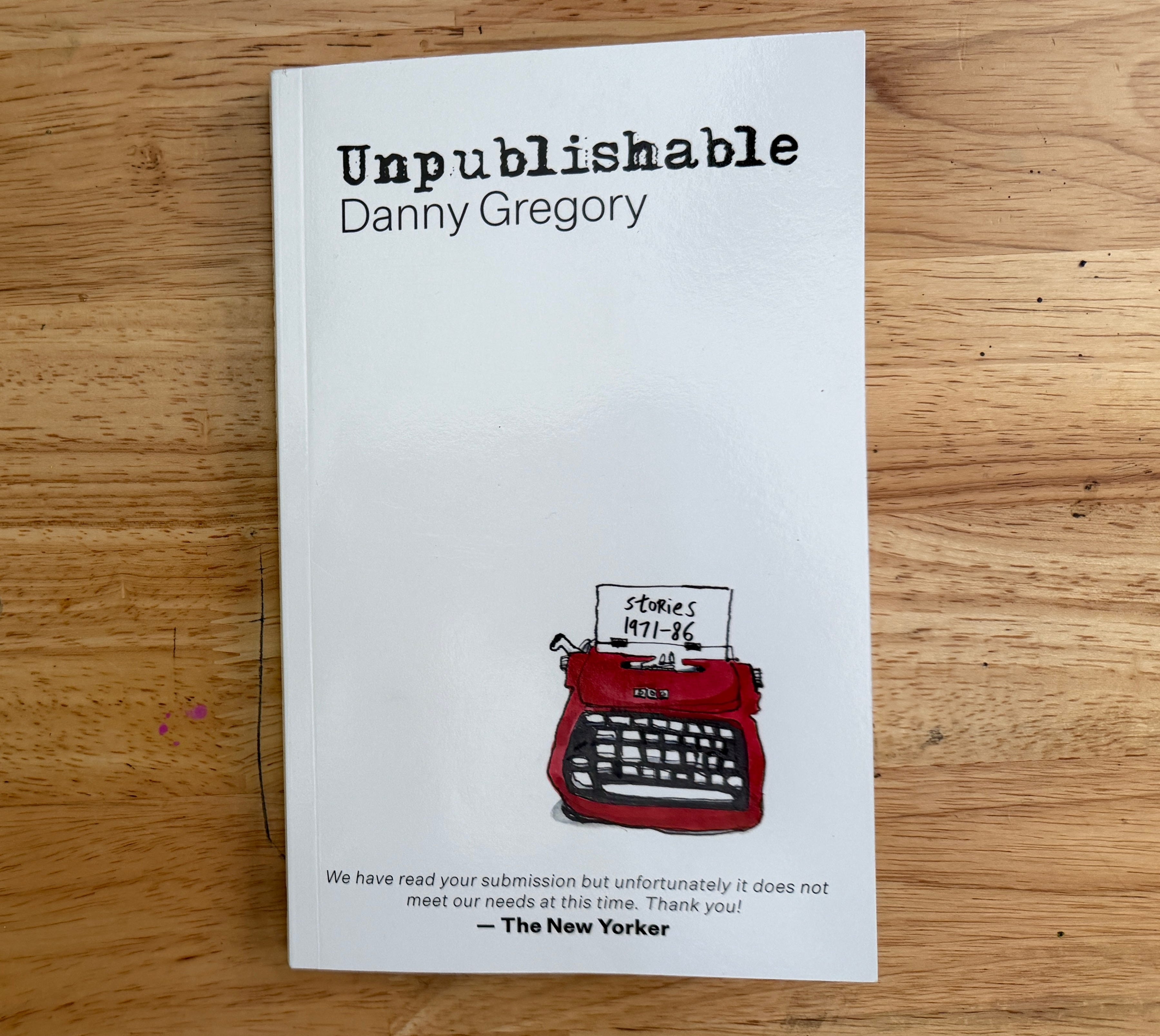
You can see Unpublishable for sale here. In paperback, ebook, and audiobook.
If you buy a copy, I hope you enjoy the book. Maybe it’ll get you thinking about your relationship to your own past selves. Is there a project you started long ago that lost steam and ended up in the attic? Are you still living by some outdated verdict on yourself that’s quietly setting the limits on your creative life? Look back at it again — objectively, charitably — and think about what you could do with it now, with all the tools and opportunities available to you that didn’t exist back then.
Your pal,
Danny
P.S. I made a film about my process of turning this box into a book. Watch it here:
Danny, I love what you did for yourself. It was inspiring to watch your video and the whole process. Love the cover and how you thought about it, including the New Yorker quote and the quote from your 9th grade teacher. One question - I don't know InDesign yet; is this doable using the Figma tool?
What a wonderful thing to bring to completion, Danny.
I actually threw out a whole box full of little books and journals I wrote as a teen, because it didn't bring me joy anymore. Not realizing then that one changes over time, and it could have brought me joy now, or any other feeling worth having.
Love the idea, and I look forward to purchasing the book.