

When I was in middle school, I discovered a couple of magical drawing tools: tracing paper and using a grid to copy a photo.
Both of these techniques dramatically improved the kinds of drawings I could make, but they also carried a social penalty. You never wanted someone to say, “Did you trace this?” That was the ultimate humiliation. As a result, I either avoided using these tools or I lied about them and hid the truth.
We also had an art teacher who could draw a perfect circle freehand. Everybody thought that was incredibly cool. That somehow morphed into a belief that you were never allowed to use a compass to draw a circle or a ruler to draw a straight line in art class. If someone spotted a tiny pinprick on your page that revealed you’d used a compass, you were an art pariah.
In middle school, we started learning how to do research papers. We were warned not to use the encyclopedia if a teacher suspected we had copied an essay from Encyclopedia Britannica. If that happened, you got called out in broad strokes of her red pen. You were supposed to read real books, consult primary sources, and use footnotes. Woe to the kid who plagiarized or lied about his sources.
Maybe middle schoolers are just crafty little thieves and liars. It seemed like we were being handed a lot of rules about not cheating, thieving, lying or leaving the toilet lid up, and most of those lessons were invaluable. They kept us fairly honest, and they taught us a lot of ways to get away with things by hiding our true process.
My grandmother was a fussbudget and a purist about most things. She taught me that tea bags were unacceptable and that you had to use loose tea. She believed you should never eat frozen food of any kind, and that canned soup and vegetables were not even fit to feed dogs. She was a snob, but she also had a cook and several servants, so she could afford to be picky. Later, when she retired and had to cook for herself and my grandfather, she became a big fan of convenience foods and instant coffee.
For much of my youth, I held on to lots of purist notions too. If I’d been older, I probably would have booed Dylan when he went electric. If I’d been born in this century, I’d collect vinyl records, VHS tapes, and make my own pickles.
Art was no different.
For years, I was an absolutist about drawing from real life. I would draw shoes and toilets and piles of dirty dishes, but I would never draw from photographs. I had this idea that that was some sort of cheating. I’d explain it by saying that drawing from 3-dimensional objects is a much better educational experience and results in more authentic drawings. And I absolutely believe that’s still true. But there are lots of things that simply aren’t readily available to be looked at and drawn, things like rhinoceroses and Notre Dame, willow trees and naked models.
So I’ve come to believe that photo reference is, kind of, an acceptable thing. But it was only during the pandemic, when I was doing daily livestreams on YouTube and had to share my subject matter with thousands of other people while I drew, that I started to rely on photographic reference to fill many pages of my sketchbook.
After we all got our vaccines, I found another reason to draw from photographs. I now live in Phoenix, AZ, and, no insult intended, but New York just had an awful lot more cool things to draw, and it was a lot easier to just walk over and draw them. In Phoenix, it’s very hot, the buildings are by and large undistinguished, and nobody walks anywhere, so, while I could spend a lot of time sitting and drawing in my air-conditioned car, I’m perfectly fine with pulling up some images on my computer when I need something to draw.
Oh, and even though I was a purist about only drawing with a pen, I use a pencil now and again, and I own several erasers.
Sorry, but it’s taken me a while to finally figure out that art isn’t about slavishly following rules; it’s about constantly finding new ones to break.
Throughout history, artists have led the way in adopting new technologies. We have always sought better, faster, and easier ways to create. Part of that is because we’re interested in new things and new ways to work, but it’s also an economic necessity. If an artist can use technology to speed up the process, we can make more art and more money.
In his book, Secret Knowledge, David Hockney describes how he covered a wall in his studio with images arranged chronologically and saw vividly that around 1420 something changed. Art looked different. Overnight, artists could suddenly draw better, capturing people and perspective far more accurately. The common wisdom in the art history world was that suddenly, people just figured out how to draw well. As a practicing artist, Hockney knew there had to be more to this.
As he describes in the book (and in the documentary you can watch on YouTube), people were using cameras — even in the 15th century. They used lenses and mirrors to project images of people and places onto canvases, then traced and painted them.
With the help of physicists, lens makers, and historical documents, he makes an ironclad case that many artists whose work looks like photographs were actually using secret knowledge to achieve incredible results.
And why don’t we know this? Why do we think that Jan van Eyck, Caravaggio, Vermeer, and so many other important artists were magically talented artists when they were actually using these tools? And does this diminish their accomplishments?
Hockney provides a simple explanation: these were trade secrets. Even their assistants often didn’t know how they achieved these results. It gave them an edge in a world where speed and realism meant higher commissions.
But, as Hockney points out, the lenses, mirrors, and cameras didn’t make the art. The artists did, using tools to help bring their vision to life. The Secret Knowledge does not rob these masters of their originality or expressive power. They had extraordinary skills, a blend of talent, ingenuity, experience, and decades of hard work.
People have always felt that artists needed to suffer. That, if their work doesn’t come from sweat and tears and trauma, it isn’t ‘true art’. That, if you see how the magician does the trick, it loses its power.
There is also a myth that artists are a special breed apart, bestowed with some kind of divine gift. We need to believe that Michelangelo painted the entire Sistine Chapel on his own (two coats!). So we ignore all those nameless apprentices who painted backgrounds for Rafael and da Vinci and so many geniuses who followed. Similarly, we never know about all the trade secrets each atelier jealously guarded.
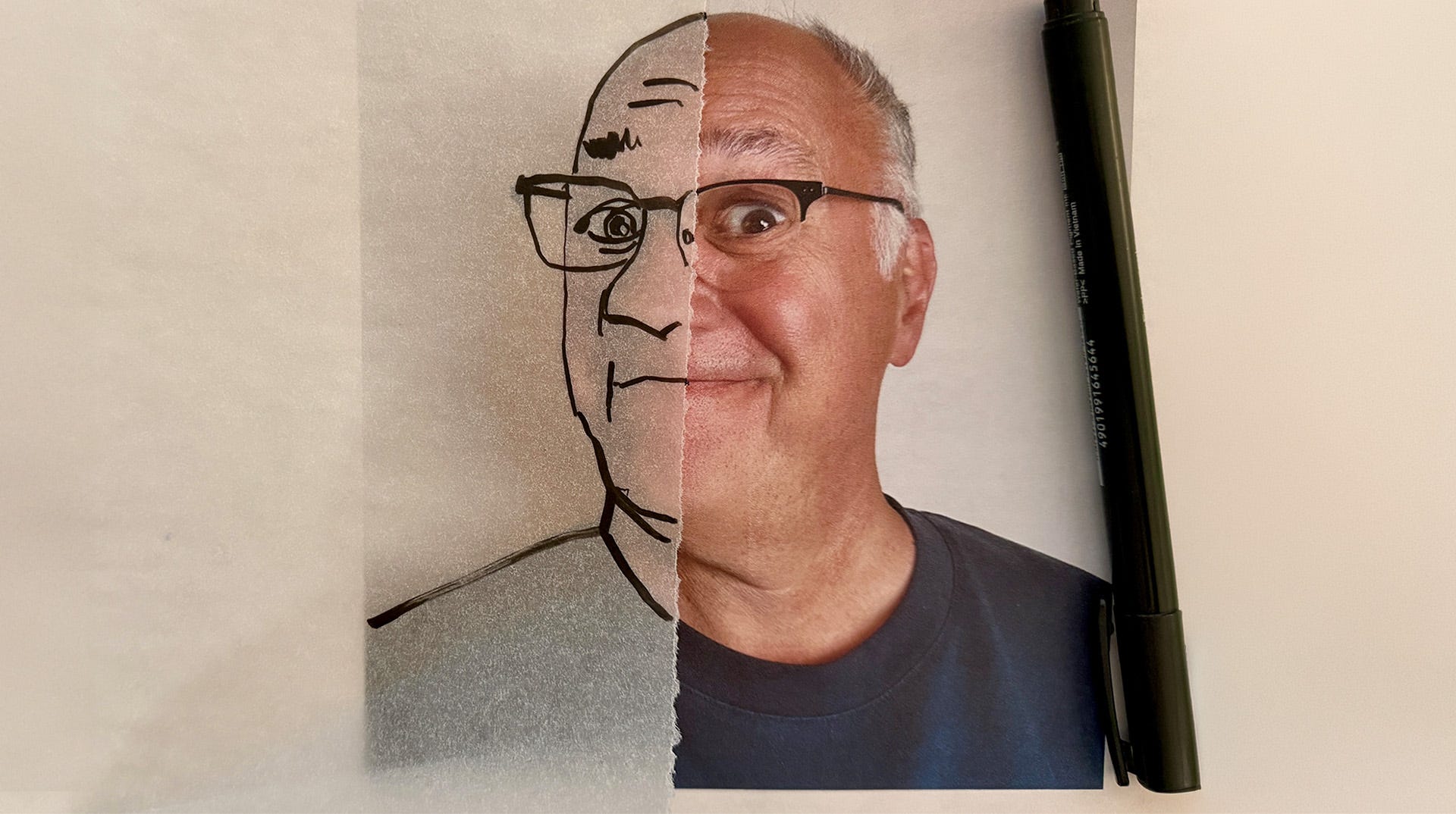
When people complain about AI stealing artists’ work, I appreciate the sentiment, but I’m skeptical. The fact is, artists and photographers have always had their work stolen by unscrupulous people. And artists have always borrowed other artists’ work, often without credit.
Andy Warhol cheated all the time. He made photo stats of pages from the Daily News and screen printed them onto canvas or projected and traced them. Roy Lichtenstein copied comics. Van Gogh copied Japanese woodcuts. Bacon copied Muybridge. And every artist, no matter how great, stands on the shoulders of the ones who precede him.
And all the artists who never cheated? They were just never caught.
I think people who aren’t artists are more troubled by the idea of artists cheating than other artists are. Photography, the airbrush, paint in tubes, Procreate, and even the “maulstick” (a stick to steady the hand) were all once called cheating.
Artists know that it’s just part of the job. Art isn’t the Olympics. There is no “standard equipment.” Use what works.
Maybe one day, AI will be able to draw as inaccurately and wonkily as I do. Maybe it’ll even be able to paint with gouache and tempera sticks. Even if some future model of artificial intelligence could duplicate every page in every one of my sketchbooks, there’d really be no point.
It will never be “Danny generated.”
For me, the process of making art is what matters, not the result. The feeling of sitting and staring at an old shoe, a sandwich, or some dirty laundry. The sensation of a Lamy Safari nib scratching across a page of Vellum Bristol. Of a sable brush skating across the surface of a creamy pan of cad yellow. And of 65 years of experience and emotions, ideas and dreams, joys and fears guiding the movement of these digits of flesh and bone. I don’t think any technology will be able to simulate that experience. And even if it could, why bother? I already have a device that does it sitting between my ears.
I’m done with ‘Secret Knowledge’ in my own studio. I’m putting away the shame of the middle-schooler who hid his tracing paper, because Jan van Eyck didn’t feel guilty, and neither should I.
Your pal,
Danny
This week's essay reminds me of "The Art Lesson" a picture book written and illustrated by Tomi dePaola. You and many of your readers might be familiar with it. For those who aren't, I am including a link to a YouTube read-along. I think many pages will bring smiles to the face of any artist who can find 8 minutes for some quiet time to recall their inner child. Danny, thanks for checking in every Friday.
"The Art Lesson" by Tomie dePaola read aloud by Mrs. F:
https://www.bing.com/videos/riverview/relatedvideo?q=tomie+di+paola+the+art+lesson&&mid=B07F069E7ADA3298F6BDB07F069E7ADA3298F6BD&churl=https%3a%2f%2fwww.youtube.com%2fchannel%2fUC7X3WLnqnHgLSDOFWfbxAGw&mcid=1AFEE3B3E3CD43BE9F79686048D36EF9&FORM=VAMGZC
Thanks Danny, I used to be a Hyperreal oil painter and it still took hundreds of hours to make a medium sized painting. I had to put my brushes down to get a real job several years ago.
I wasn't doing any art.
Since discovering you on YouTube last August you inspired me to get a pen and draw anything and everything. I have. I can say from this last 8 months the drawings I have done in my home made sketchbook, made of old mail and scrap papers have been more special to me than many of my large photoreal oil paintings! Also storing them doesn't fill up my garage! Bottom line is I am hooked on small sketchbooks and the process of sitting and looking. Thanks for inspiring me!