At 5:30 in the morning, the light in Phoenix comes in almost horizontal, and the wall by the start of the Biltmore Circle takes it full in the face.
It’s a long whitewashed retaining wall around somebody’s compound, with ornamental spouts for carrying off rain that hardly ever comes. Bougainvillea spills over it in a couple of places.
On my hundredth trip past it, I stopped and stood there a while, feeling like I’d been there before.
I knew it, the way you know your bedroom in the dark.
It took me a beat to place it from where. Lahore. 1969.
There was a wall like that on the street running up to my grandparents’ front gate. Raw whitewash, longer than this one, and behind it a dusty paddock with a single bullock standing under a gnarled tree and a couple of loafing crows. I haven’t been there in fifty years.
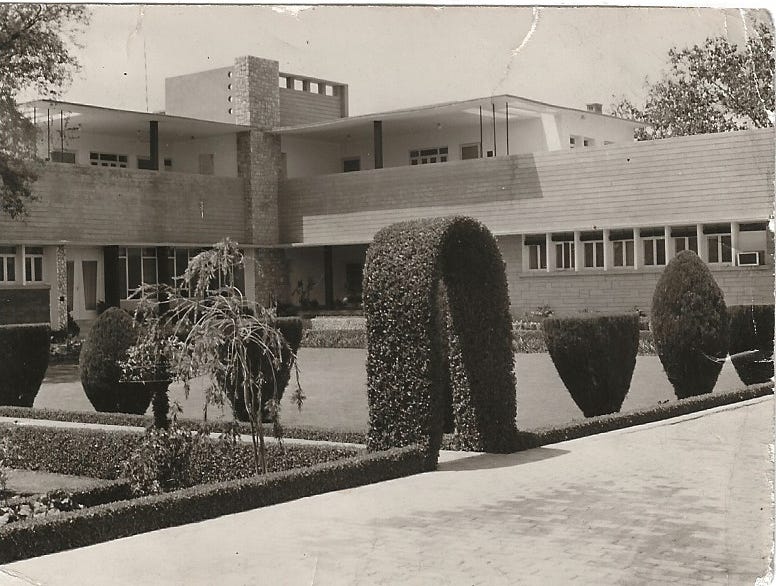
My grandparents’ mid-century modern house.
My mother sent me to Lahore when I was eight and a half. My sister had just been born, Mum was finishing a PhD in Australia and living with the man who’d become her third husband, and it was, as they say, a lot.
So I was put on a plane.
My grandparents were doctors and ran their practice out of the front of the house. I called them Gran and Ninny.
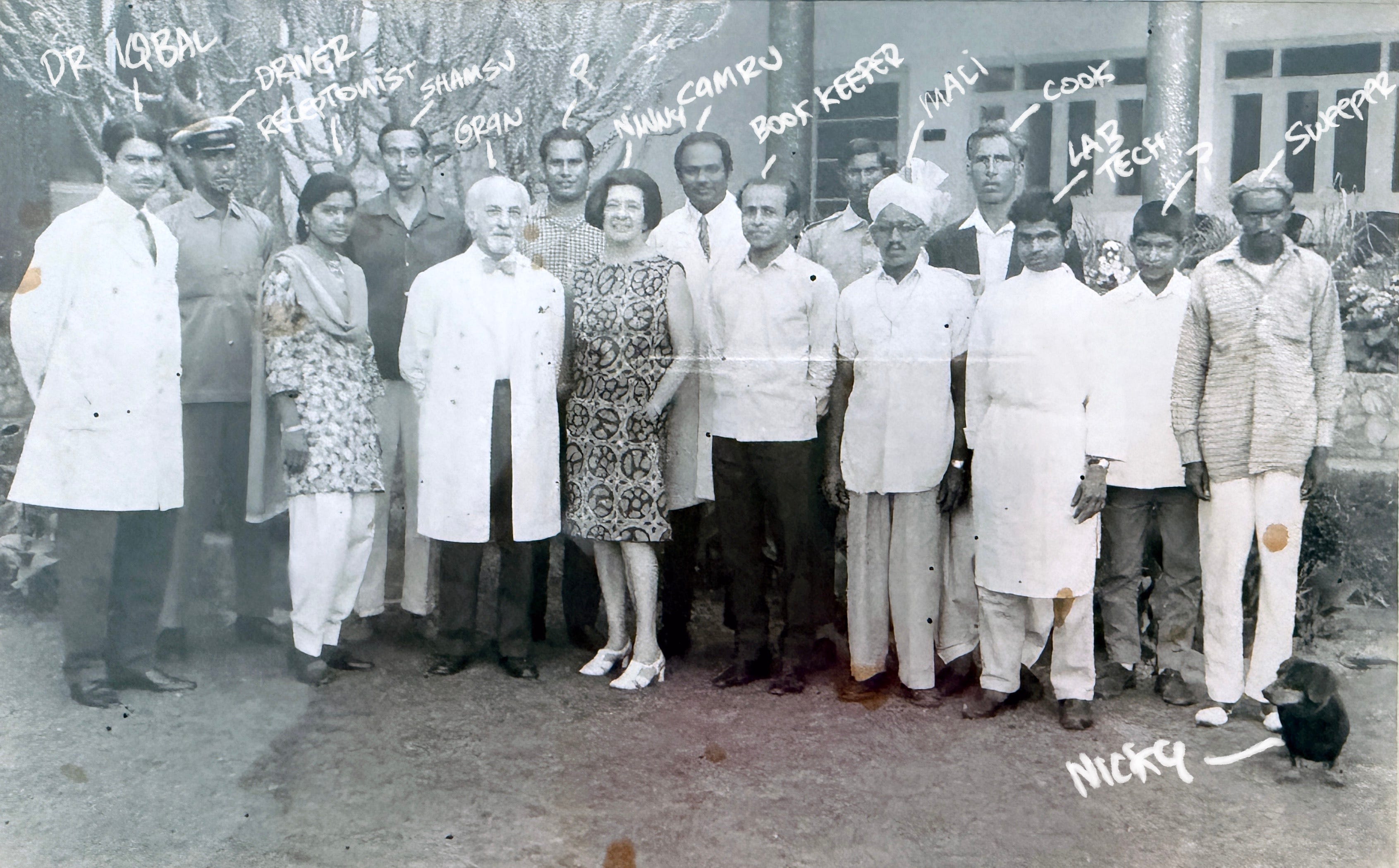
There was a driver from Peshawar who took me to school in the morning and collected me after lunch. A head bearer named Shamsu. A gardener I called Mali. A cook. A sweeper who worked his way around the house and yard all day. Patients coming and going through the surgery. Two boys about my age, Nimu and Papa, who played cricket with me in the afternoons, and a foul-tempered dachshund named Nicky who played with nobody.
Grinny and the gang.
Everybody called me chota sahib. Little sir. Which, at nine, is an excellent thing to be called.
By then I’d already lived in London, Canberra and Pittsburgh, and I’d get through a dozen more schools before I was done. But Lahore was the place I thought of as home. I’d been coming here since I was two.
Once I’d noticed the wall in Phoenix, I started paying attention to everything else that seemed familiar. Bougainvillea, frangipani, oleander. Crows squabbling at dawn. Doves cooing. Lizards doing pushups on a hot wall. There were jackals yipping beyond the gum trees. Here we have coyotes.
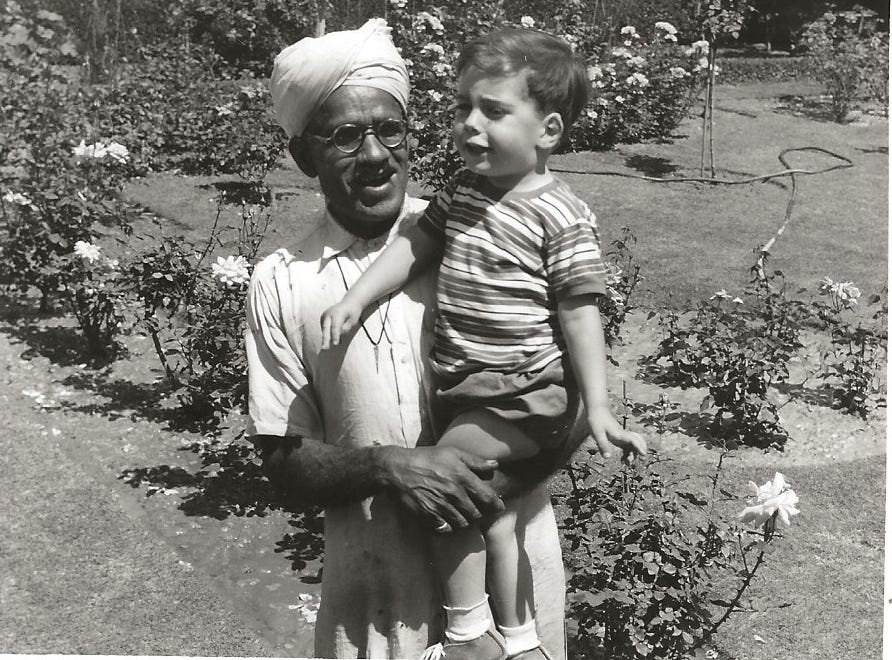
Mali and me in the rose garden.
Mynah birds sat on the power lines in Lahore. Nimu told me that if you caught one and fed it raisins you could teach it to talk, and we spent most of a summer on that project without ever getting a word in reply. Here I’ve got mockingbirds working through a set list of other birds’ material at four in the morning a.m. I wonder if they like raisins.
The most powerful, visceral memories flood me on summer nights as I step through the patio doors. Out of the air conditioning into an atmosphere that’s still ninety-five degrees, amber sodium light, humidity, cicadas and crickets sawing away. That is Lahore. That is precisely Lahore, and I am nine on my grandparents’ back terrace.
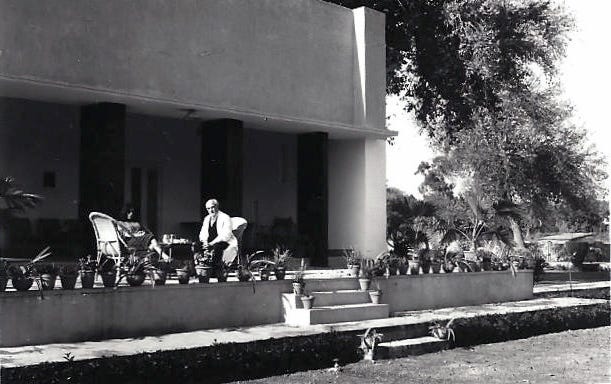
Gran on the terrace with a chota peg.
Then there’re the monsoons. In Lahore, the rain would flood the front garden in about four minutes, and Nicky and I would tear through the puddles, exhilarated and wild. When the storms finally broke on my first July in Phoenix, and I felt that smell of wet dust and creosote coming up off the ground, it was a perfume as familiar as Ninny’s Chanel No. 5.
I started Googling.
Lahore sits at 31.5 degrees north. Phoenix at 33.4. The same belt around the planet, the same sun angle, the same length of day, the same appalling summers. That belt has a name, the subtropical ridge, a ring of descending dry air, wringing out the clouds and leaving deserts underneath wherever it settles. The Sonoran is one of them. So are the dry plains outside Lahore.
Neither city would exist without canals — the Hohokam dug theirs here a thousand years before us; Shah Jahan started Lahore’s in 1639. And both cities got the same midcentury-modern treatment in the sixties: low flat-roofed houses, carports, breeze block, picture windows onto the garden. Gulberg, where my grandparents lived, was master-planned in the 1950s and in old photographs looks uncannily like Arcadia.
Dig straight down through Phoenix, and you’d surface in the Indian Ocean, spluttering four thousand miles short of Lahore. Fine. There is still a directish line running through the middle of the earth and the middle of my life, and it’s off by a bit, like most things.
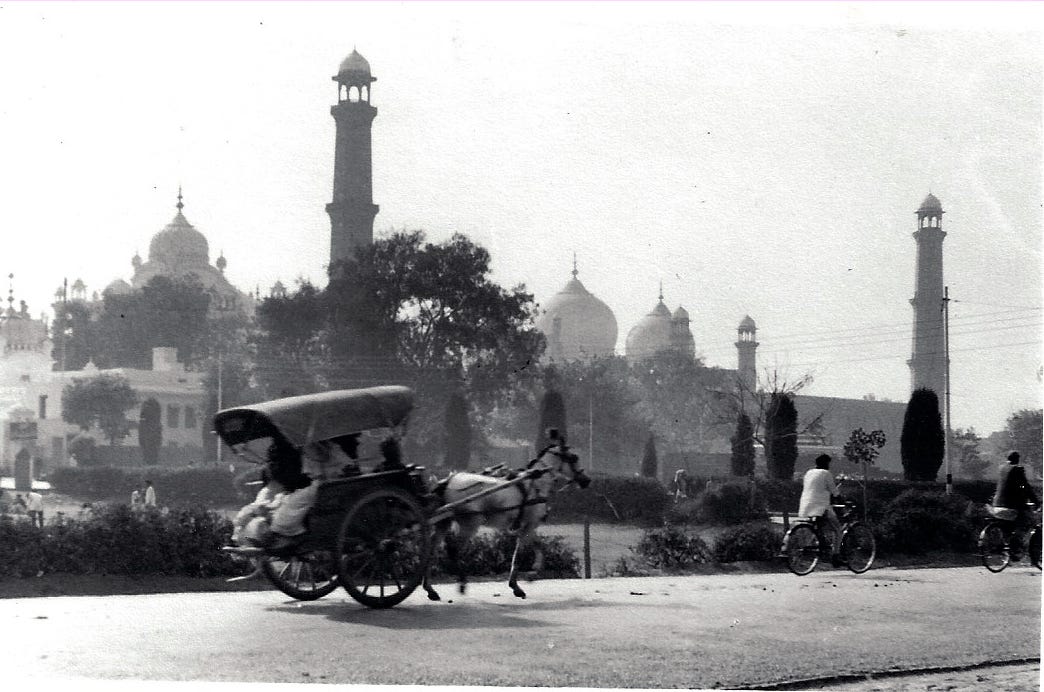
Typical Lahore street scene, circa 1969.
I didn’t pick either place.
When I was eight, I was put on a plane because the grown-ups’ arrangements had come apart. When I was fifty-nine, JJ and I flew out West for a visit, and COVID slammed the door behind us, and we never went home to New York.
Both times I landed somewhere I hadn’t chosen, with no vote in the matter, in the middle of a general collapse of the way things had been.
And both times the place turned out to be kind to me. The one stretch of my childhood when I felt safe and looked after has been quietly reissued, in a different language, at the far end of the earth, right when I needed it a second time.
JJ grew up here and doesn’t see any of it. I’ll say something about the light on a wall, and she’ll look at the wall and see a wall. The people I’ve met from Lahore don’t see it either, because they never got the Arizona half. There’s nobody walking around with this particular overlay but me.
Maybe you’ve got one too. Some ordinary place or thing you run into that flicks you back to a place you can’t get to anymore. I’d love to know what sets yours off.
Mine’s a wall. 5:30, before it gets hot.
Your pal,
Danny
Thanks for reading Danny’s Essays! Subscribe for free to receive new posts and support my work.
I enjoy your writing, it's very soothing, interesting, and comforting. I can visualize every part. I imagine your childhood must have been fascinating; and subconsciously secure to have been loved and accepted in such a way by such interesting grandparents. I love reading this.
I could write more about the things that take me back, but I somehow never know when to stop, and you have better things to occupy your time than reading the melancholy blatherings of an old(er) woman.
Suffice it to say, by the time we reach a certain age, these memories are the things that bring us everything that made us. The good, the bad. Spreading them all out on the mind's table enables one to relish it all as good; because in the long run, all of those experiences made us who we are now; and thus, even the bad ugly ones morph into an odd sort of good.
We can see the blessings and the benefits of the trials in our lives, gruesome as they were to endure, they give us perspective, and compassion, and a drive to seek the good in everything. For ourselves. For others. Thank you for the generous reminder.
How you describe your observations reminds me of a favorite poet of mine, Ted Kooser. It pulls me in & I imagine experiencing the story myself. And yes it does make me reminiscent of warm times in my past. I am grateful to have had the safe & good to break up the not so good. Thank you for writing the way you do.



I enjoy your writing, it's very soothing, interesting, and comforting. I can visualize every part. I imagine your childhood must have been fascinating; and subconsciously secure to have been loved and accepted in such a way by such interesting grandparents. I love reading this.
I could write more about the things that take me back, but I somehow never know when to stop, and you have better things to occupy your time than reading the melancholy blatherings of an old(er) woman.
Suffice it to say, by the time we reach a certain age, these memories are the things that bring us everything that made us. The good, the bad. Spreading them all out on the mind's table enables one to relish it all as good; because in the long run, all of those experiences made us who we are now; and thus, even the bad ugly ones morph into an odd sort of good.
We can see the blessings and the benefits of the trials in our lives, gruesome as they were to endure, they give us perspective, and compassion, and a drive to seek the good in everything. For ourselves. For others. Thank you for the generous reminder.
How you describe your observations reminds me of a favorite poet of mine, Ted Kooser. It pulls me in & I imagine experiencing the story myself. And yes it does make me reminiscent of warm times in my past. I am grateful to have had the safe & good to break up the not so good. Thank you for writing the way you do.
Doyce Kolb