

On my last trip to Europe, we spent a blazingly hot month in Amsterdam and finally got to the Rijksmuseum and the Van Gogh Museum.
Vincent van Gogh has always been a massive inspiration to me. I love his colors, his ferocity, but most of all, the whole journey of discovery he took trying to beat and bend himself into being an artist.
In just ten years, he went from painting awful brown crap into changing art for all time. I’ve always even a kindred spirit because of the way he went about teaching himself, how he absorbed so many influences, how he went down one path after another to get clearer and more direct in his work. He spent a few months in art school, studied under a couple of professionals, read loads of instructional books, but most of all, he just painted and painted, often filling a canvas a day, day after day.
As you can imagine, I was really excited by the enormous show called “Van Gogh at Work.” It focuses entirely on this process, showing how Vincent learned and evolved through more than 200 drawings, paintings, and sketchbooks. There are exhibits of his easels, paints, palettes, preparatory drawings, and loads of completed masterpieces in a sweeping chronological exhibition covering four entire floors.
I learned a huge amount in the hours I spent there.
First, there was the shock of seeing all these amazing paintings as working examples, rather than “Priceless Masterpieces®,” which gave them an immediacy that helped me understand how Van Gogh himself must have seen them.
Have you ever had the experience of seeing an artist with his own work, how he might rub the paint with his thumb, or want to repaint a corner, or throws them onto a stack in the corner? Artists have such a different relationship with their pieces than curators or gallerists who tiptoe around with white gloves and X-ray machines because artists value the process of their art as much, if not more than the actual products of that process.
Van Gogh would paint on the back of old paintings or just scrape them down so he could make something new. He would knock out stacks of paintings of the same subject, trying new and different things. When you see, for example, both paintings of his room at Arles, two versions of an iconic image hanging next to each other, similar but different in a hundred ways, you feel the living artist behind them, how he thought and developed, what he was considering, where he saw mistakes that became lessons. How often he would make copies of his paintings to give them to other people or just to brighten up his room. All those priceless sunflowers — he made them so that Gauguin would be happy in a cheerfully decorated room when he came to Arles.
And he was such a thirsty sponge. He was always studying others, absorbing, mimicking, incorporating, and then surpassing a long list of iconic painters who seem at first to be his betters but ultimately look regressive, formulaic, and only of their moment, now past, thanks to Van Gogh.
You get the sense that people are always telling him, “No, this is how you must make Art,” from the one professional teacher in his hometown who briefly mentored him, to the teachers at the Académie who gave him the worst marks, to the Impressionists who opened his eyes in Paris to Gauguin and on and on.
Everyone knows better, and he seems to listen, guilelessly. But, unlike them, he is never satisfied, never thinks he has the final answer and keeps pushing on.
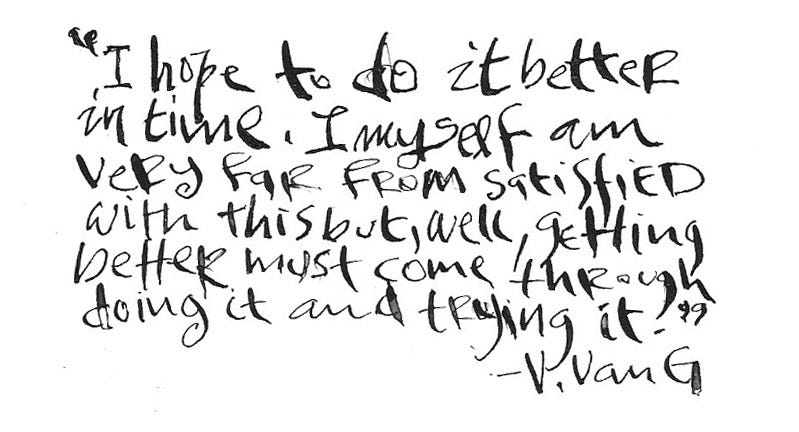
You could sense how hard he was working and how he kept pushing himself onward. Even if he liked a painting he’d done, he would try something new. A new approach, a new subject, new materials, different canvas sizes... new, new, new. He never felt like the journey was over, that he had arrived; there was so much more to discover.
I love that hunger and enthusiasm.
And, as the show’s chronology takes him (and you) from milestone to milestone, you can see his work progress and retain certain things that make them all Van Gogh. He copies and copies and copies — Impressionists, Dutch masters, Japanese Woodcuts, all of his friends from Lautrec to Seurat, absorbing each influence, going down byways and dead ends, accumulating new ideas and ways of seeing, and yet each brushstroke can’t help but look like his. He couldn’t help being Van Gogh.
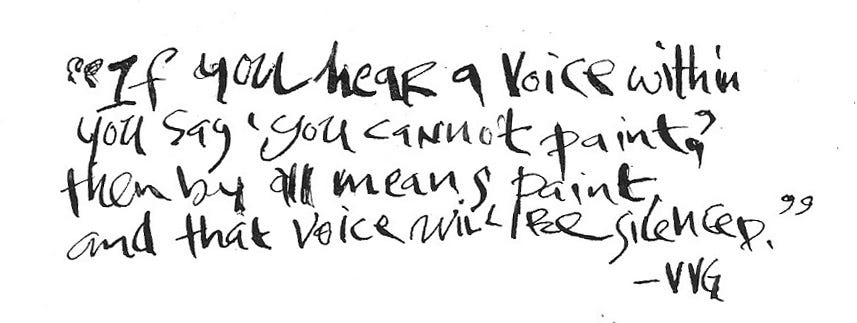
His passion never diminishes, and the miracle of what he is making himself into through sheer force of will is exciting and inspiring. No matter how familiar the images look, seeing them in the flesh makes them new and exciting.
Oh, and he is always drawing.
There are lines over and under the paint that define and clarify everything. That’s been my desire with my paintings too, but it never seems “painterly,” but he shows how it can be. His influences are those Japanese woodcuts, Lautrec, and Gauguin — lines that are sometimes black or in contrasting colors or just darker shades or hues of the blocked-in shapes. Or lines that graduate in color and tone along their length. Sometimes the lines are picture elements: a branch, a window frame, a doorway, the edge of a petal, but often they’re just there to separate planes and outline color fields.
Also: I was surprised to learn that he used store-bought, pre-stretched canvases. And that for an extended period, he relied on a wire perspective frame to help him draw more accurately. Cheating? I don’t think so.
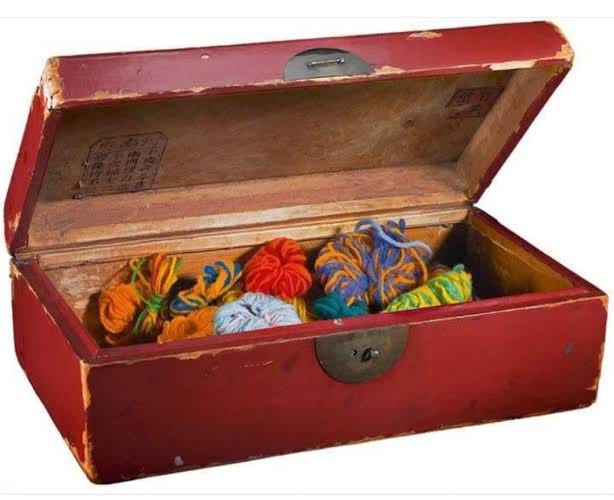
And I learned that he would use lengths of colored wool to plan out the color compositions of his paintings. They displayed the actual box full of balls of yarn that corresponded to many of his most famous works.
And finally, I saw that his work is a record of his life. He painted the people he knew: lovers, friends, neighbors, postmen, landlords. The places he lived. The cafés he ate in. The landscape all around him. His subjects had meaning to him, and it shows in his best work.
When he does academic work, painting from professional models or plaster casts, it feels dull and lifeless. But when he paints sunflowers that he picked, irises he wants to decorate a room he’ll live in, the difference is palpable.
I have always loved his painting of almond blossoms against a teal background, which he painted last, carefully outlining every branch. Now I know that he painted it so carefully for his newly born nephew, blossoms for a fresh life, and there is love and care in every stroke.
Great art isn’t scary and imposing and “Important.” It’s personal and full of feelings. At some point, van Gogh gave up making paintings to be sold — that seemed like it would never happen. Instead, he made so many paintings because he had to, he wanted to, he had problems to unravel, and the world around him was beautiful and cried out to him to be embraced.
The last two paintings in the show left me with a lump in my throat, like the ending of a great 1940s movie. The wheat field aswirl with crows, big wet-on-wet strokes he slapped down in the baking sun. It’s a painting that’s well-known as a symbol of his tortured state.
But the very last painting was one I had never seen before. It’s of the roots of trees, tangled like snakes, and it’s unfinished. It was his last lesson, and he never completed it.
What must that last day have been like, him stopping in the middle of a painting and deciding that he’d had enough, that it was hopeless, and putting a revolver to his chest? One can never know.
But as I walked down from the fourth floor of the museum, after seeing all of his hard work over the years, all of his experiments and discoveries, his catching up to and then surpassing so many other great artists, it was so sad to think that, in the end, van Gogh felt he had failed.
Imagine if Vincent had known how loved he would soon be.
How we would all learn from his lessons and discoveries. How his works would become icons, decorating tea towels and boxer shorts.
And that the voice in his head was utterly wrong, despite how it seemed that one lousy day.
The monkey is almost always wrong. And the only answer is to keep trying and pushing and learning and discovering. The road has no end, just lots of twists and turns, and it keeps moving upwards even if we can’t feel it all the time.
Your pal,
Danny
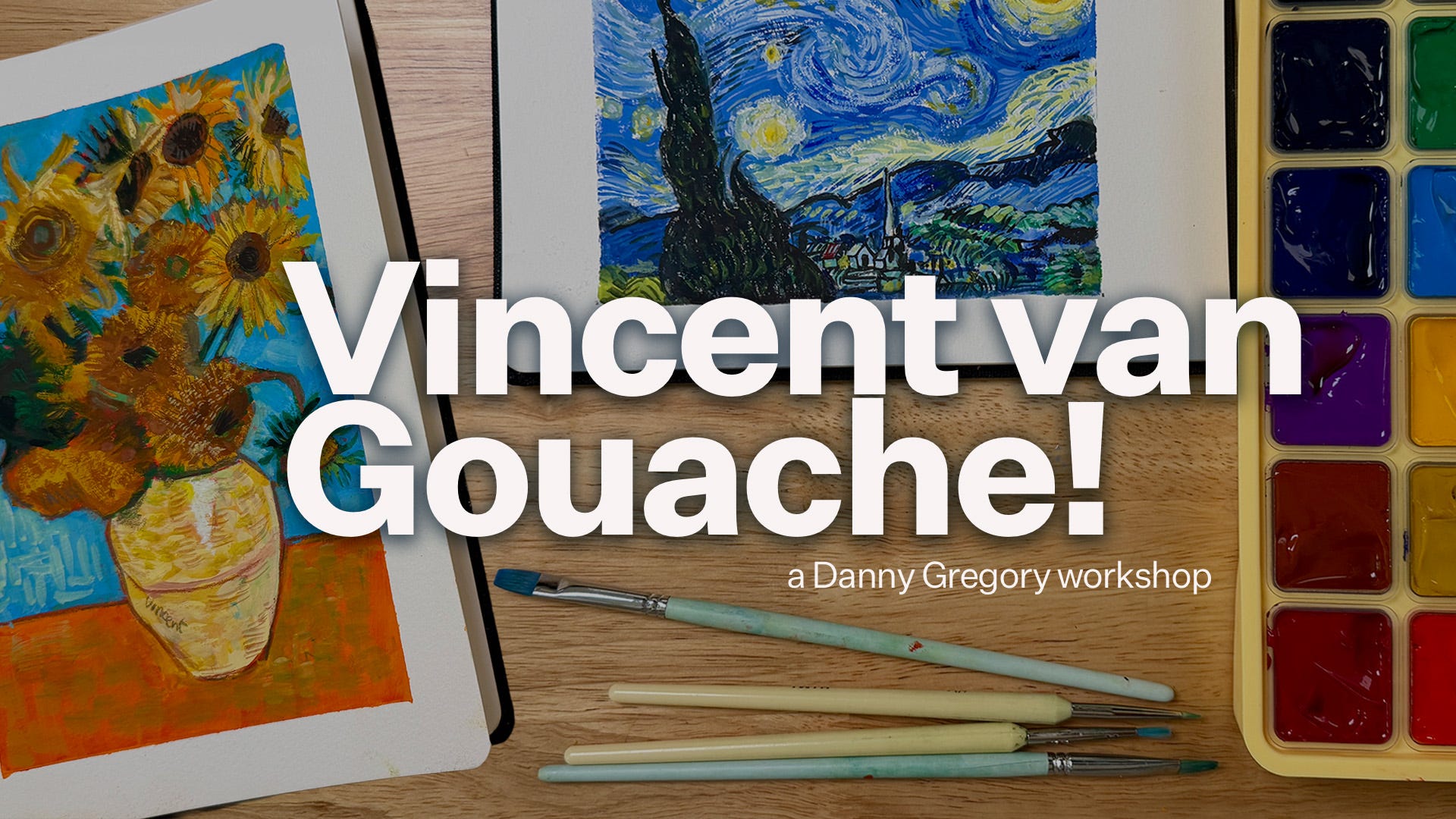
P.S. If you got this far in this essay, you might be interested in my next workshop, Vincent van Gouache. We’ll spend three fun hours together and emerge with interpretations of two of his masterpieces (and both of our ears). If you’d like to learn more, click here.
As much as I know about Vincent Van Gogh, I love to hear his story and learn new things. I’ve not heard of the yarn before. Van Gogh’s art is the first I loved, as a child—his painting of his bedroom had me transfixed. Why would someone paint something so ordinary? I loved it and also this essay on Friday morning. Looking forward to Vincent VanGouache. And thank you for your many gifts!
Enjoy all your essays but this one in particular. I love the things about Van Gogh you appreciate and his paintings in the Van Gogh museum, well anywhere, move me emotionally every time no matter how many times I see them. There is a clip on You Tube from Dr. Who where Dr. Who takes Van Gogh into the future to a showing of his paintings to show him what the world thinks of his paintings since his death. Look it up.